 EQBase
Guide
Does macOS have a built-in equalizer?
Last updated: August 8, 2026
No. macOS has no system-wide equalizer. There is no setting anywhere in System Settings that applies EQ to everything your Mac plays, and Apple has never shipped one. The Music app includes its own 10-band equalizer, but it affects audio played through Music and nothing else. Some individual apps (VLC, Spotify, most media players) ship their own EQ, and each one affects only that app. To equalize everything, meaning browser video, calls, games and every other app, you need third-party software that sits between your apps and your speakers. What that asks of you varies: some of these apps install an audio device on your Mac and need your password to do it, while others, EQBase among them, install nothing and simply ask permission to use your Mac's audio.
That's the whole answer. The rest of this page explains each option and why the limitation exists.
What macOS gives you on its own
The Music app equalizer
Open the Music app and choose Window → Equalizer. You get a 10-band graphic EQ with a set of named presets and a manual mode. It's a real equalizer and it's free, with two limits worth knowing: it only affects audio playing through the Music app, and it's a fixed 10-band graphic EQ, so you can't set your own frequencies, bandwidths or filter types.
If all you listen to is your own music library in the Music app, this may genuinely be all you need.
Equalizers built into individual apps
Some apps ship their own. VLC has an equalizer under its audio effects, Spotify has one on some platforms, and most DAWs and media players include EQ of some kind. Each one affects only that app, and each has its own interface, so a change you make in one is invisible to the others.
What macOS does not offer
- No global EQ that applies to all system audio.
- No per-app volume mixer of the kind Windows has had for years.
- No headphone correction for specific headphone models. (Third-party correction curves exist for thousands of them: see headphone EQ settings for Mac.)
- No way to apply a measured correction curve to everything you hear.
Why isn't there one?
macOS routes audio from each app to an output device through Core Audio, and Apple provides no user-facing processing stage in between. Apple has never shipped a global equalizer, and there's no supported setting that adds one.
What Core Audio does allow is for software to step into that path itself, either by publishing its own audio device or by reading the mix your Mac is already playing. Both are supported by Apple, and that is the opening every system-wide equalizer on macOS works through.
How third-party system-wide equalizers work
They all do the same three things:
- The app gets hold of everything your Mac is playing. Some do this by installing an audio device that appears in your sound settings and becomes your output; others simply read the sound your Mac is already sending out.
- Every app's audio ends up passing through it, whichever way it got there.
- It processes that audio (equalization, volume, correction) and passes the result to your real speakers or headphones.
Two things follow from this. First, how step 1 works decides what setup asks of you. Apps that install a device need your password once, and macOS counts capturing the audio back as microphone access, so they ask for that too. Apps that read the sound directly, EQBase among them, ask for one thing instead: permission to use this computer's audio. Second, quality depends entirely on what happens in step 3: whether the processing adds latency, and whether it leaves the signal untouched when you aren't asking it to do anything.
If an app does install a device, a well-built one uses a user-space audio driver rather than a kernel extension, and can be removed completely by its own uninstaller.
Your options
| Option | Cost | Affects | Control |
|---|---|---|---|
| Music app equalizer | Free, built in | Music app only | 10 fixed bands, presets |
| Per-app equalizers (VLC, Spotify…) | Free where they exist | That one app | Varies, usually basic |
| eqMac | Free, open source; paid tier | All system audio | Parametric, per-app volume in the paid tier |
| Boom 3D | Paid, one-time | All system audio | 31-band EQ plus 3D enhancement effects |
| SoundSource | Paid | All system audio, and per app | Per-app EQ, volume and output routing |
| EQBase (ours) | Free tier, no time limit; Pro from $4.99/mo | All system audio | 10-band to 24-band parametric, 8,600+ headphone corrections |
We've written honest comparisons with eqMac, Boom 3D and SoundSource, including where each of them is the better choice, which for a lot of people they are. For the whole field at once, see the best Mac equalizer apps in 2026.
If your problem is specifically that one app is too loud next to another, rather than tone, see per-app volume control on a Mac. If it's that everything is too quiet, see how to make your Mac louder. And if the bass changes depending on where you sit, that's the room, not the Mac; see room correction on a Mac.
Common questions
Can I EQ system audio without installing anything?
You need an app, but not necessarily an audio device on top of it. Some of these apps install one, which is the step that asks for your password. Others, EQBase among them, install nothing extra: you download the app and grant one permission to use your Mac's audio, with no password and no restart.
Does a system-wide equalizer hurt audio quality?
It doesn't have to, but it can, and the difference is entirely in how the software is built. There are three things to check. Transparency when idle: a well-built equalizer is bit-transparent when set flat, meaning the samples that come out are mathematically identical to the ones that went in, not merely close. Latency: processing can delay audio, which shows up as lip-sync drift on video and lag in calls and games; a well-built one adds zero samples to the direct signal path. Clipping: boosting frequencies raises peak level, so an equalizer without headroom management or a limiter will distort loud material the moment you add gain.
Most products don't state any of this, and a few actively resample or dither everything all the time. If it matters to you, look for one that claims transparency explicitly and lets you verify it while it runs, rather than one that simply doesn't mention it.
Will it work with Bluetooth headphones and AirPods?
Yes. The processing happens before audio reaches the output device, so it works with any output your Mac supports: built-in speakers, USB, HDMI, AirPlay or Bluetooth.
Can I undo it?
Yes. If the app installed an audio device, use its uninstaller rather than just deleting the app, or the device can be left behind. If it installed nothing, dragging the app to the Trash is enough. EQBase is the second kind, unless you turned on one of the two optional features that do install its driver, and those come with an uninstaller.
If you want to try one
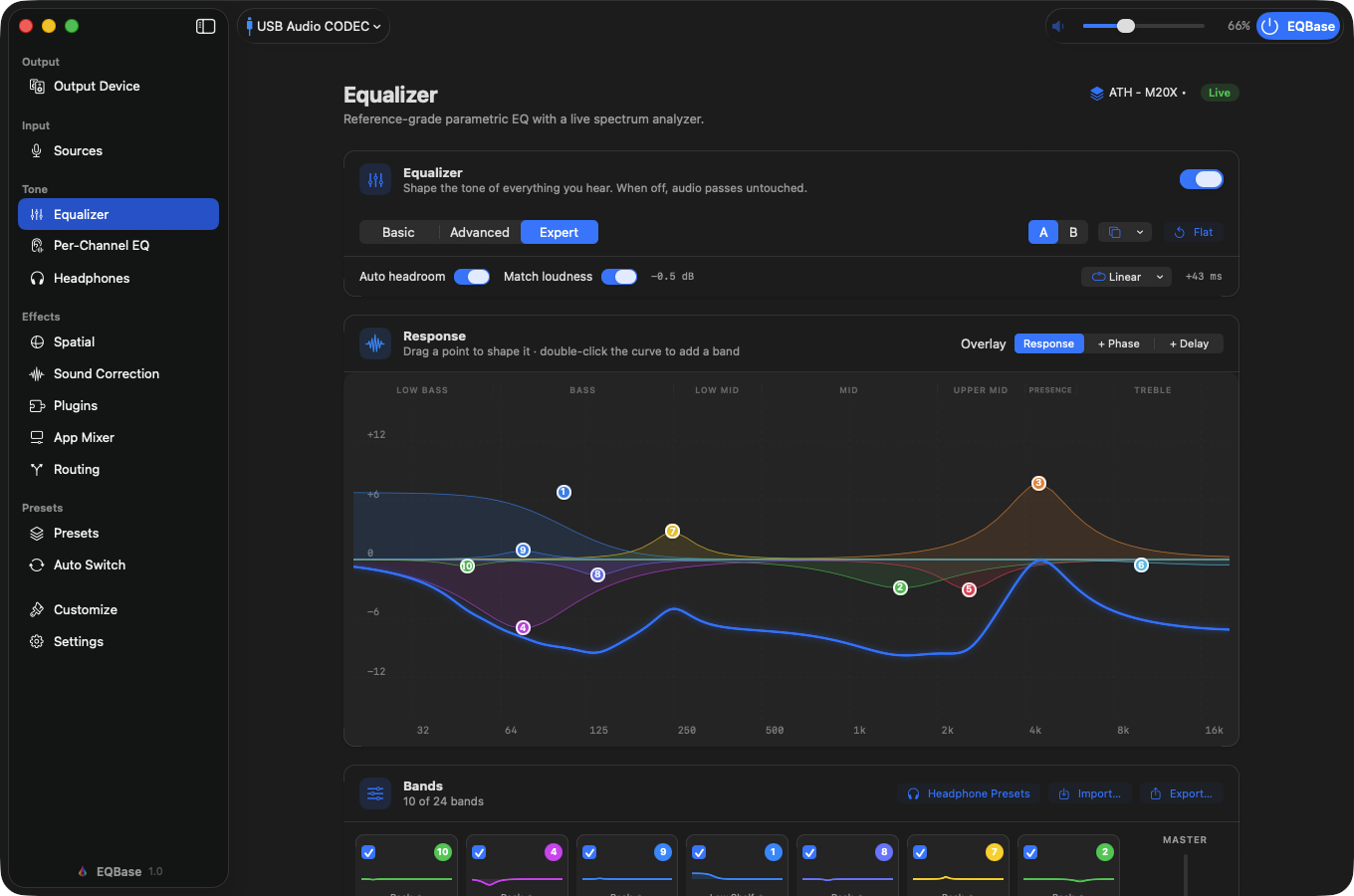
EQBase is our take: a menu-bar equalizer for all system audio with a free tier that has no time limit, correction profiles for 8,600+ headphone models, zero added latency, and a bit-perfect signal path when everything is flat. It needs macOS 14.4 or later.